Scoliosis Cobb Angle Measurement
AI-powered spine segmentation and automatic Cobb angle calculation
Research tool — not a regulated medical device. Their results are not a diagnosis and can be wrong. Every result must be reviewed by a qualified clinician, who remains responsible for the clinical decision.
What it does
Measures the Cobb angle on a full-spine radiograph by automatically locating the vertebral endplates, and reports curve magnitude and apex for scoliosis assessment.
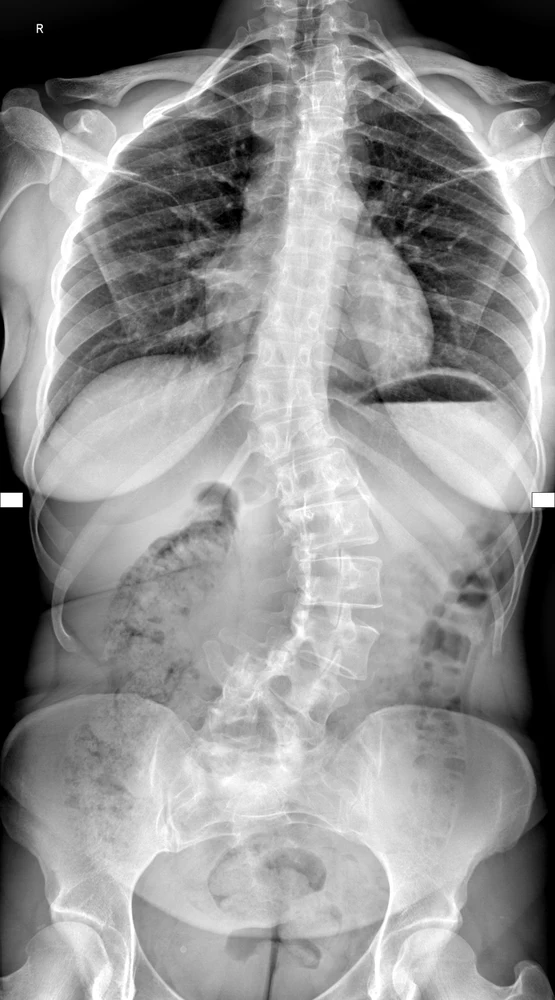
AI result

Cobb angle
39°
Moderate curve
Curves measured
3
22° · 35° · 39°
Cobb Angle Classification
The Cobb angle is the standard measurement used to quantify the severity of scoliotic spinal curvature on a posteroanterior (PA) radiograph. It is measured between the most tilted vertebrae at the upper and lower ends of the curve.
How to measure manually
- On a PA spine radiograph, identify the upper end vertebra — the most tilted vertebra at the top of the curve — and the lower end vertebra — the most tilted at the bottom. These are the vertebrae whose endplates deviate most from horizontal.
- Draw a line along the superior endplate (top surface) of the upper end vertebra.
- Draw a line along the inferior endplate (bottom surface) of the lower end vertebra.
- Erect a perpendicular to each of those two lines.
- The acute angle at which the two perpendiculars intersect is the Cobb angle. Because the perpendiculars are rotated 90° from the endplate lines, this angle equals the angle between the endplate lines themselves — so you can also measure it directly without drawing perpendiculars.
| Cobb Angle | Classification | Typical management |
|---|---|---|
| < 10° | Normal / not scoliosis | No treatment needed |
| 10°–19° | Mild scoliosis | Observation, repeat X-ray every 6–12 months |
| 20°–39° | Moderate scoliosis | Bracing considered in growing children |
| ≥ 40° | Severe scoliosis | Surgical consultation recommended |
Curves above 50° are generally considered indications for surgery, as they tend to progress even after skeletal maturity. Lumbar curves are typically better tolerated than thoracic curves of the same magnitude due to differences in cardiopulmonary impact.
About the model
Spine segmentation and Cobb angle calculation are performed using the open-source model mazurowski-lab/Scoliosis_project (Duke University, Mazurowski Lab), licensed under Apache 2.0.